Keynote Speakers Confirmed for the Sámi and Indigenous Conference
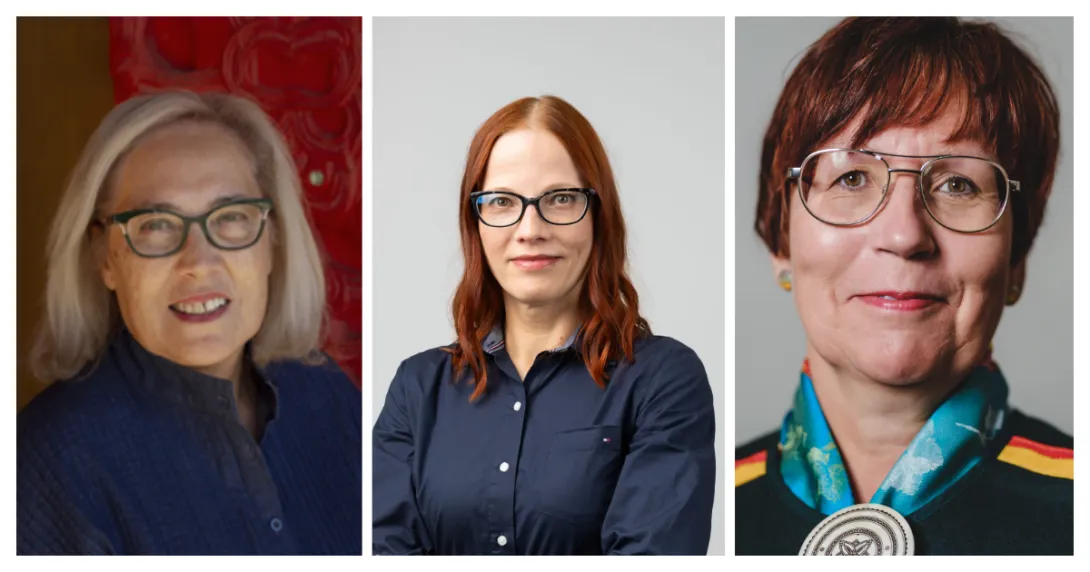
In October, Sámi University of Applied Sciences will host the Sámi and Indigenous Education Conference. This year’s keynote speakers are Professor Linda Tuhiwai Smith, Professor Rauna Kuokkanen, and Professor Ylva Jannok Nutti. The theme of the conference is "To manage in a manifold world today and tomorrow."
What kind of Indigenous people/s are we educating?
Dr Linda Tuhiwai Smith is a Distinguished Professor at Te Whare Wānanga o Awanuiārangi in Whakatane New Zealand. She is Māori and from the iwi of Ngāti Awa, Ngāti Porou, Tuhourangi and Ngāti Paoa. Distinguished Professor Smith is an internationally renowned and highly awarded researcher, scholar and writer known for her work on Decolonising Methodologies, Kaupapa Māori and Māori Education. In her talk she will attempt to answer two questions: What kinds of world/s are we educating for and what kind of Indigenous people/s are we educating to be in these world/s?
- Read the full abstract
Honouring the past while Educating for Indigenous Futures
What kinds of world/s are we educating for and what kind of Indigenous people/s are we educating to be in these world/s? My talk will ask and attempt to answer these questions.Our world conferences on Indigenous education ‘WIPCE’ have demonstrated how much Indigenous communities have grasped the potential of education (both formal and informal) to support aspirations for language, knowledge and cultural revitalisation. The breadth of professional and community knowledge and practice on these areas is inspiring. But what comes next? What do our future generations expect, aspire for and need to continue living and being Indigenous peoples, self-determining and free from the trauma of colonisation? What comes next, for example, once the language begins to thrive? Does that automatically mean the people will thrive, that our knowledge systems and cultures will thrive? Are we educating for perpetual struggle? These are some questions I invite you to contemplate alongside me.
The importance of Sámi deliberation practices
Jovnná Jon Ánne Kirstte Rávdná is Professor of Arctic Indigenous Studies at the University of Lapland in Rovaniemi and comes from Fierranjohka by the Deatnu/Tana River. Prior to this, she was Professor in the Department of Political Science and the Indigenous Studies Program at the University of Toronto (2008–2018). She holds a PhD from the University of British Columbia, Canada. In her talk she will explain why Sámi deliberation practices are necessary for thriving in a diverse world today and tomorrow
- Read the full abstract
Ovttastallan and Siiddastallan – how to strengthen Sámi deliberation practices (to thrive in a diverse world today and tomorrow)
Anishinabekwe artist and an Idle No More organizer Wanda Nanibush once made a passionate case for the centrality of Indigenous children, arguing that “children and their wellbeing is the first and last question.” Later, Nanibush elaborated her point: ideally in Indigenous governance systems, children would be not only at the center of the community life but ultimately, of all political decision-making so that “all decisions made are actually about the child.” The idea of children and their wellbeing being “the first and last question” is probably at the heart of Indigenous and Sámi education as well. In my talk, I will consider Nanibush’s suggestion by discussing Sámi practices of Ovttastallan and Siiddastallan. I also present a challenge to Sámi educators to teach and strengthen deliberation skills and culture to Sámi children from an early age. I explain why this is necessary for thriving in a diverse world today and tomorrow, as the conference byline also suggests.
Teachers as keepers
Ylva Jannok Nutti is Professor in Education at the Sámi Teacher Education Department at Sámi University of Applied Sciences, and she served as Vice-Rector from 2019 to 2023. Professor Ylva Jannok NuttiShe completed her primary school teacher education in 1998 and worked as a teacher at the Sámi School in Jokkmokk, where she began developing Sámi traditional knowledge in education. She completed her Licentiate degree in 2007 and earned her PhD in Pedagogy in 2010 from Luleå University of Technology. In her talk she will explore how Sámi epistemologies are expressed through everyday pedagogical choices, relationships, and language practices, while also acknowledging the challenges teachers navigate
- Read the full abstract
Sustaining Indigenous Language and Living Knowledge: Teachers as Keepers of Continuity in Sámi Schooling
Sámi knowledge and worldview are enacted in Sámi primary schools as part of broader Indigenous efforts to sustain language, traditional knowledge, and relational connections to eana (land) through education. Schooling is understood as a space of relational responsibility and cultural and linguistic dignity for Indigenous children. Within this perspective, eana is not merely a backdrop, but a living and knowledge-bearing presence central to Indigenous ways of knowing. Drawing on the educational philosophy of Per Fokstad, education is framed as an ethical commitment grounded in love for the mother tongue, cultural continuity, and responsibility toward Sámi children’s lived realities. The talk draws on qualitative interviews and classroom observations in Sámi primary schools. It explores how Sámi epistemologies are expressed through everyday pedagogical choices, relationships, and language practices, while also acknowledging the challenges teachers navigate: limited Sámi teaching materials, time pressure, language shift, and the enduring legacy of assimilation policies. Sámi education derives its strength from teachers’ relational awareness and ethical positioning. Through their daily work—often carried out within structural constraints—Sámi teachers sustain living knowledge systems and contribute to Indigenous educational continuity, renewal, and future-making.
The Sámi and Indigenous Education Conference was held for the first time in 2017, and this is the fourth time the conference is being organized.
You can find more information about the conference here, and more information about the keynote speakers here.